The Moment Everything Shifted
I need to tell you about the night I realized romantasy had a problem, and it wasn’t the problem I thought it was. I was scrolling through my feed around midnight, the way you do when you’re supposed to be sleeping but instead you’re doom-reading book reviews, and I saw something that stopped me cold. A BookTok creator with half a million followers had posted a video titled “I Can’t Read Another One” with a montage of nearly identical fantasy romance covers: windswept women with swords, brooding men with perfect abs, forbidden love, eternal courts, and some variation of betrayal or discovery in the third act. The comments were brutal. Readers weren’t just tired. They were angry. They felt duped.
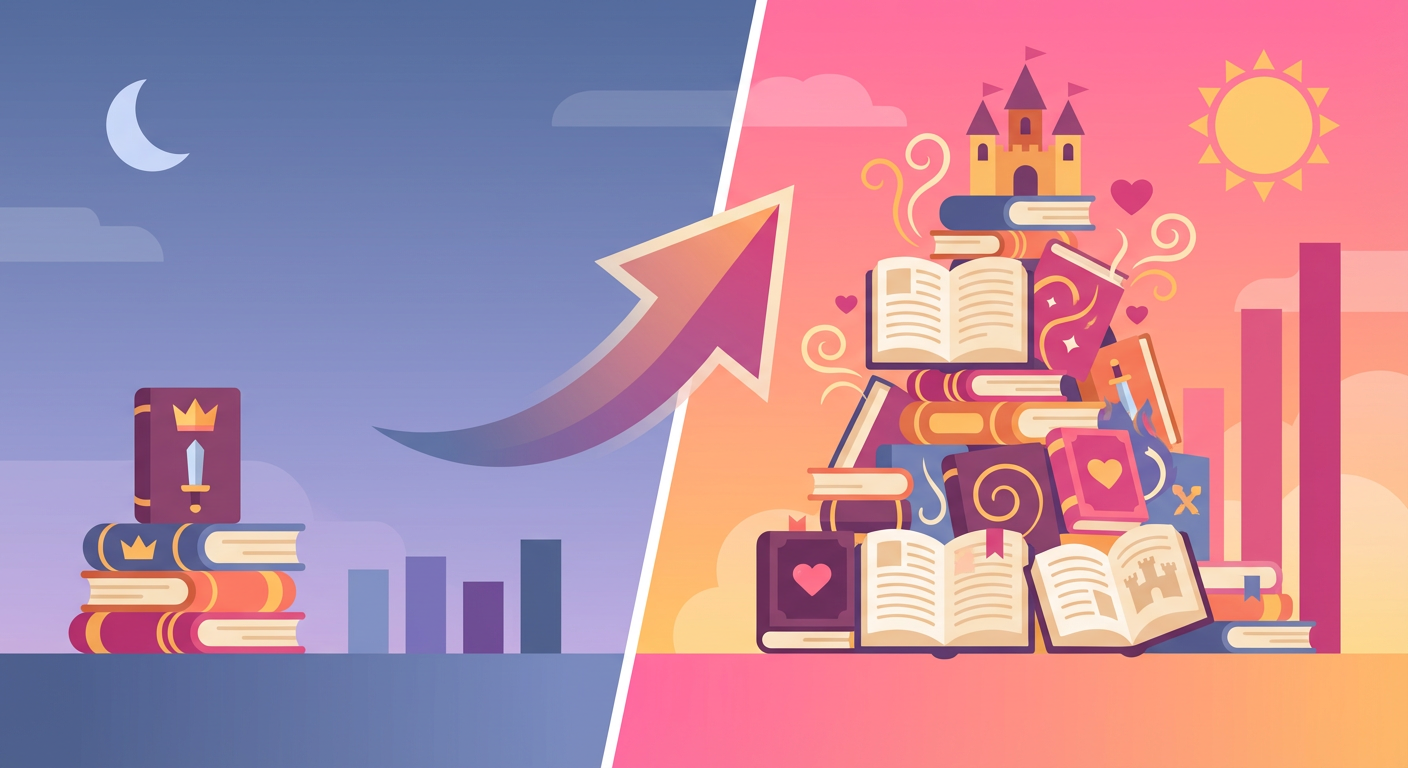
What struck me most wasn’t the criticism itself. It was how unanimous it felt. For years, we’d been celebrating romantasy as this brilliant evolution of genre fiction, a space where epic worldbuilding met emotional depth. And it still is that. But somewhere between 2023 and now, the market decided that if one Sarah J. Maas book works, then four hundred books using her exact template must work even better. According to Publishers Weekly 2025 genre fiction report, the romantasy category exploded from roughly 60 titles annually in the 2019-2021 period to over 400 titles between 2023 and 2025 alone. That’s a 600 percent increase in just four years. The market was flooded, and readers noticed immediately.
The Numbers Don’t Lie, Even When They’re Uncomfortable
Here’s what fascinates and deeply troubles me about this moment: Sarah J. Maas herself isn’t the problem, and I say that as someone who has complicated feelings about her work. According to Bloomsbury Publishing investor reports, Maas’s combined series sales crossed 50 million copies worldwide by 2025. That’s not a fluke. That’s proof that readers genuinely connect with her storytelling. But here’s the thing about proof of concept in publishing: once something works, every publisher and their cousin decides they need their own version of it. The problem isn’t that Maas wrote compelling romantasy. The problem is that the industry looked at her success and decided the formula was the point, not the artistry.
The backlash shows up in the data in ways that can’t be ignored. Goodreads Choice Awards analysis from 2025 revealed that romantasy received 31 percent more negative reviews citing “formulaic plots” than any other genre category. Thirty-one percent. That’s not a vocal minority. That’s a significant portion of your readership collectively saying: we see what you’re doing, and we’re not interested anymore. These readers weren’t criticizing the genre itself. They were criticizing the assembly-line repetition that had replaced actual storytelling. There’s a real difference, and publishers are finally starting to understand it.
The Reckoning: BookTok Declares Independence
If you want to understand where reader sentiment shifted, look to the #PostRomantasy hashtag that exploded across BookTok in late 2025. Creators with massive platforms started actively recommending that their audiences take a break from romantasy entirely. They suggested dark academia, literary horror, even experimental science fiction as palate cleansers. The hashtag generated over 400 million combined views, and it wasn’t some fringe movement. This was the mainstream reader community saying out loud: we loved this genre, and we’re choosing to leave it for now because we need something different.
What made this genuinely interesting to me wasn’t the rejection itself. It was how sophisticated the rejection was. These weren’t people saying romantasy is bad. They were people with genuine reading literacy making a curated choice about their reading diet. They understood that a three-course meal of identical dishes loses its appeal. They were looking for contrast, complexity, surprise. They wanted to remember why they fell in love with reading in the first place, and they’d realized that reading the 47th variation of a specific story structure wasn’t getting them there.
What Publishers Learned (And Are Actually Acting On)
This is where things get genuinely hopeful, and I mean that. Tor Books and Orbit, two of the most influential fantasy imprints in the industry, made significant announcements in early 2026 about their upcoming acquisitions. They’re deliberately seeking what trade publications are calling “romantasy-adjacent but subversive” projects. That phrase matters. It’s not a rejection of the category. It’s an acknowledgment that readers still want romance and fantasy together, but they want the recipe changed. They want surprise. They want voices that aren’t trying to replicate someone else’s bestseller. They want actual innovation instead of iteration.
What I find genuinely moving about this moment is that publishers are listening. They’re not abandoning romantasy. They’re being pushed to make it good again. The genre isn’t dying. It’s being forced to actually earn its readers back. And that matters because it means the people who burned out on formula have a reason to return when something genuinely fresh arrives.
What This Means for Your Reading Life in 2026
So here’s what I think this all means for us, for you specifically, for anyone reading this at midnight because you can’t sleep without finishing just one more chapter. The romantasy backlash isn’t a bad thing. It’s readers collectively insisting on better. It’s the market correcting itself the way markets eventually do when they get drunk on their own success and forget that quality matters.
If you’ve felt frustrated by romantasy lately, you’re not alone, and more importantly, your frustration isn’t a personal failing. You haven’t outgrown the genre. You’ve simply developed better taste, and the market is finally catching up to what you already knew. The next wave of romantasy will be better because it has to be. Publishers understand now that volume without quality is just noise.
I’d genuinely love to know what you’re reading right now, especially if you’ve stepped away from romantasy and found something else that’s captured your heart. What made you make that shift? Are you looking to come back to the genre, or have you discovered something entirely new that’s filled that space? Tell me in the comments or come find me on whatever platform you’re using. I’m the one reading three books simultaneously at midnight, and I’m always ready to talk about exactly this kind of thing.