The Book That Would Not Stop Being Discussed
I kept seeing All Fours everywhere for months. On the subway, in coffee shops, in that particular category of Instagram story where someone photographs a book spine with some version of “this is destroying me emotionally.” By the time I picked it up in late 2025, the novel had already spent over a year accumulating an almost mythological reputation. Miranda July’s debut novel came out in May 2024 and then just refused to leave the cultural conversation. It kept showing up on bestseller lists, kept sparking think pieces, kept making people argue with strangers on the internet about what they had just read.
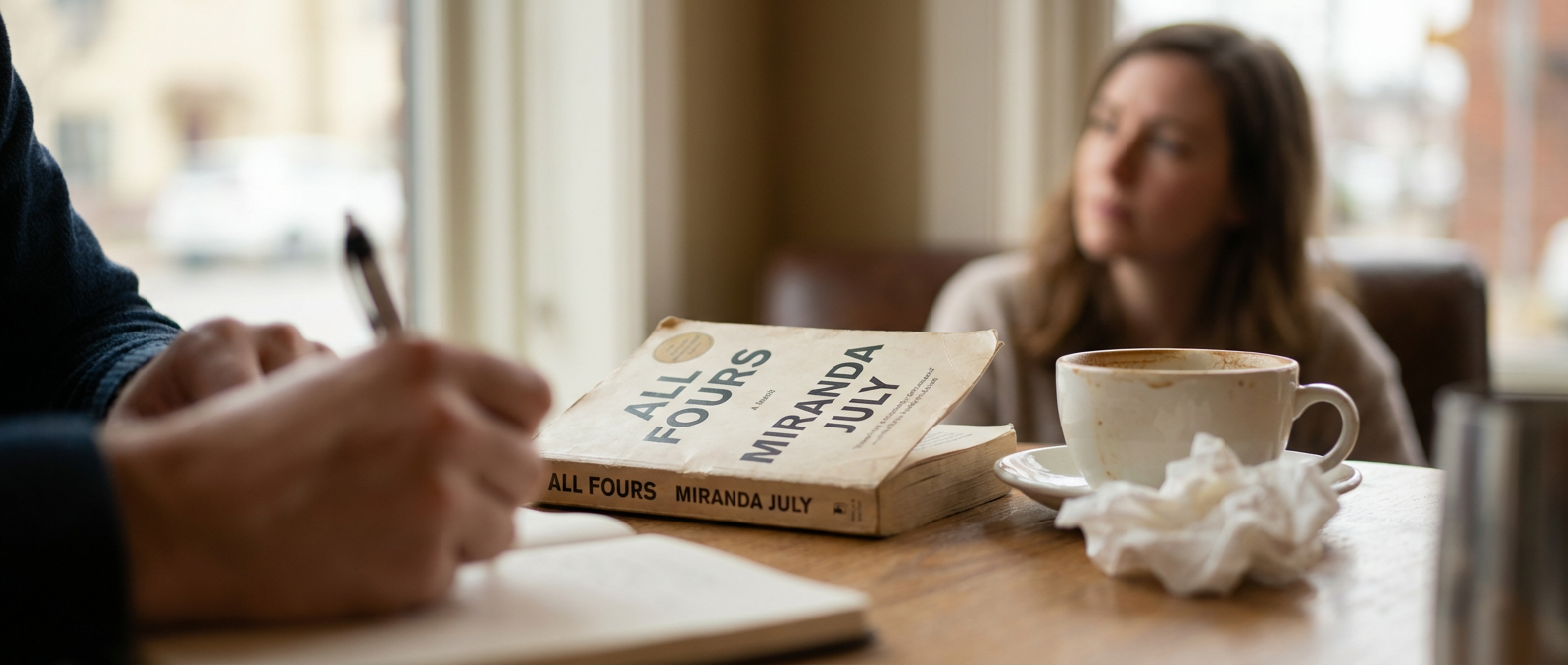
What I did not expect was how deliberately provocative the book would feel. Not provocative in a shock-value way, but in the way that a mirror held up at the wrong angle becomes confrontational. The novel spent over 52 weeks on various bestseller lists according to industry tracking, which is remarkable not just for the duration but for what it suggests about readership: people kept buying this book, kept reading it, and kept wanting to talk about it. That kind of sustained attention usually means something deeper is happening than simple entertainment or even critical acclaim.

The Perimenopause Conversation That Cracked Open Publishing
Here is what fascinates me most about All Fours: it became the site of a serious cultural reckoning about representation, and it happened fast. The New York Times published three separate opinion pieces about this novel between June 2024 and March 2025, all circling around the same question of how literature represents women in their forties moving through bodies that are changing. That is an unusual amount of editorial real estate for a single book. It signals that something about July’s approach to perimenopause as a central narrative theme broke through whatever invisibility has historically surrounded this subject in literary fiction.
The novel won the 2025 PEN/Faulkner Award for Fiction, which is remarkable for a different reason: it was the first time this prestigious prize recognized a work of fiction that made perimenopause not a subplot or a passing reference but the actual structural spine of the story. As a finalist for the Women’s Prize for Fiction that same year, the book was suddenly being read by more people than any author could have anticipated. What I realized while reading was that July had not written a book about menopause the way medical literature approaches it. She had written a character study, a narrative about desire and shame and the particular invisibility of middle-aged female sexuality, and perimenopause is simply the bodily reality that makes all of that urgent and undeniable.
Why Everyone Has Such Different Reactions to This Book
The Goodreads ratings for All Fours tell a story that traditional bell curve distribution cannot capture. Over 850,000 ratings accumulated by early 2026, and what literary critics immediately noticed was the distinctly bimodal pattern: people were rating this book either five stars or one star, with far fewer ratings in between. This is not accidental. July stated in a March 2025 interview with The Paris Review that she deliberately wrote the novel to “not be likable in the way women’s fiction is expected to be likable.” That quote went viral because it articulated something readers had been feeling but struggling to name: the book refuses the emotional comfort that genre conventions have taught us to expect from women’s narratives.
I want to sit with that distinction for a moment because it matters for how we talk about genre and constraint. Women’s fiction as a commercial category operates within certain unspoken rules: the protagonist grows, learns something, moves toward a kind of resolution that feels earned and true and ultimately affirming. There is nothing wrong with that structure. But All Fours operates with different rules entirely. The main character makes decisions that actively harm her relationships. She wants things that contradict other things she claims to want. She does not resolve into wisdom or self-knowledge in any satisfying way. She simply exists in all her contradiction and confusion, and the novel refuses to resolve that for her or for us.
Genre Constraints and What They Let You Write
What strikes me about reading All Fours in conversation with the literary marketplace is how the choice to work in genre or outside it fundamentally shapes what stories get told and how. Miranda July comes from performance and visual art, which means she approaches the novel form without the same inherited obligations that a career literary writer might carry. She was not trained to write likable protagonists or satisfying emotional arcs. She was trained to provoke, to make people uncomfortable, to sit with contradiction.
I have been thinking about this in relation to other books that broke their expected genres this year. The difference between a book that works within a genre’s constraints and one that deliberately violates them is the difference between mastery and rupture. All Fours is a rupture. It takes the conventions of a certain kind of women’s literary fiction and cracks them open from the inside. The perimenopause plot could have been handled as tragedy or enlightenment narrative. July instead treats it as pure material: what does a body in change want? What does she do with that wanting? What happens when she acts on it? She does not judge the answers. She simply watches.
Why This Book Mattered and Why I Needed to Tell You About It
I read All Fours in three days, and I am still angry at it, which I think is the appropriate response. I found myself arguing with the characters on the page, frustrated with the protagonist for her selfishness, and then frustrated with myself for expecting different behavior from her. The novel held up a particular mirror and I did not like what I saw in it, which is perhaps the entire point. If you are looking for a reading experience that will comfort or affirm you, Miranda July’s All Fours on Goodreads is not what you need right now.
But if you are interested in what happens when an artist from outside the traditional literary establishment takes on fiction and refuses to apologize for what emerges, if you want to read something that will crack open conversations about bodies and desire and the particular invisibility of middle-aged women, if you are ready to sit with ambiguity and contradiction without resolution, then this book is waiting. The fact that it spent over a year dominating conversations about contemporary fiction suggests that something in it resonated across very different kinds of readers, even when they disagreed completely about whether that resonance was a good thing. That is the kind of book I cannot stop thinking about. So what did you think? Did it destroy you the way it destroyed everyone else?