The Promise We Make Each Other
There’s something almost sacred about the moment you discover a literary friendship. You know the feeling: you’re reading about Virginia Woolf and Vita Sackville-West, or C.S. Lewis and J.R.R. Tolkien, and suddenly you’re convinced you’ve found the blueprint for the deepest kind of human connection. These relationships seem to exist on a plane above ordinary friendship, elevated by shared genius and mutual artistic understanding. We read about their letters, their long walks discussing philosophy and craft, their ability to see each other’s work with both critical precision and profound love.
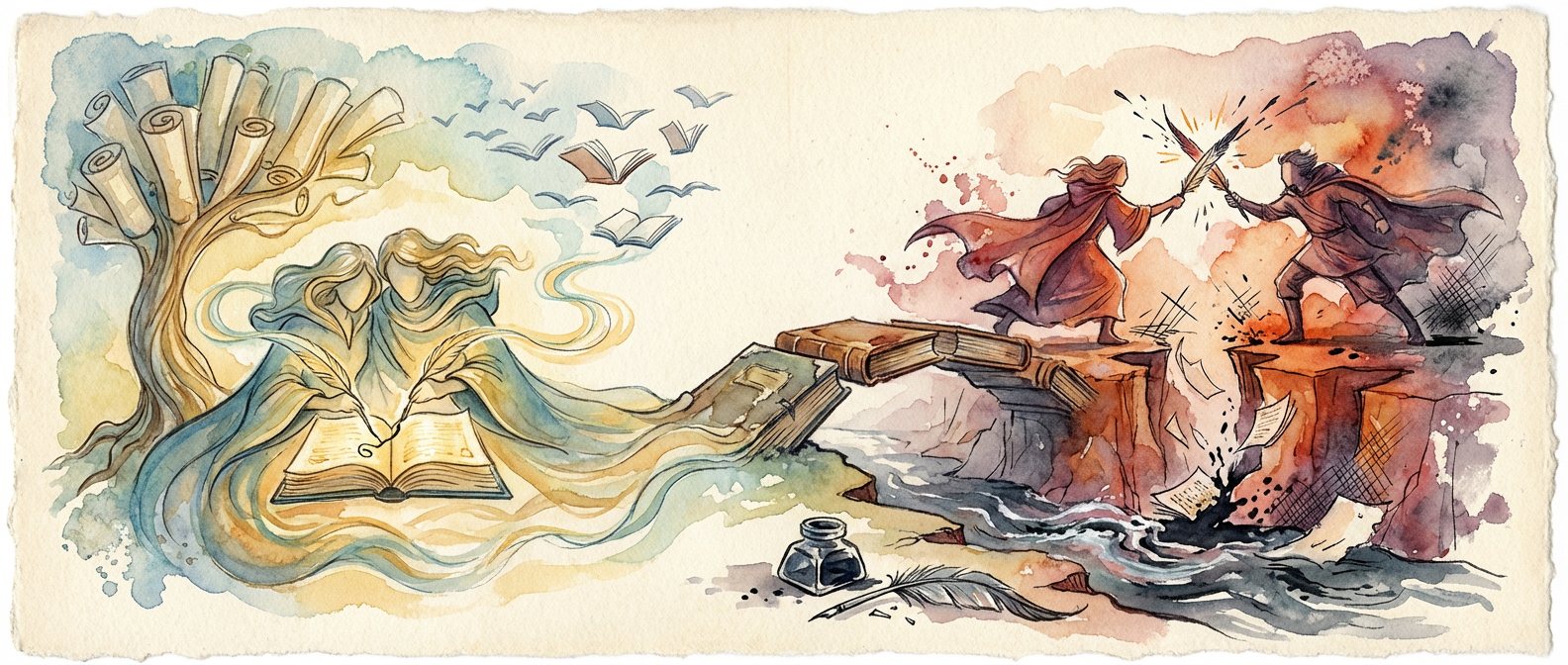
I used to collect these stories like talismans. The way Toni Morrison and Maya Angelou supported each other through decades of literary and personal challenges. How Joan Didion and Eve Babitz navigated their complicated friendship in 1960s Los Angeles, each writing the other into their work in ways both generous and cutting. These relationships promised something I desperately wanted: the possibility that creative work could be not just solitary pursuit, but genuine communion.
The disappointment, when it comes, feels personal. What we’re really mourning isn’t just the gap between expectation and reality in these historical friendships, but our own longing for that kind of connection. We want to believe that shared love of language and story can transcend the petty jealousies and misunderstandings that plague ordinary relationships. We want literary friendship to be pure in a way that regular friendship rarely is.

The Reality Behind the Romance
But dig deeper into these celebrated relationships and you’ll find the same messy humanity that defines all of us. Take the friendship between Sylvia Plath and Anne Sexton, which has been romanticized as a meeting of confessional poetry minds. Yes, they found in each other someone who understood the particular weight of being a woman writer in the 1950s. But their relationship was also marked by competition, by Plath’s resentment of Sexton’s earlier success, and by the way their shared struggles with mental illness created a dynamic that was as destructive as it was supportive.
Or consider the famous rivalry between Norman Mailer and Gore Vidal, which has been mythologized as the ultimate literary feud. The reality was more banal: two egos bruising against each other, fueled by alcohol and the particular pressures of male literary celebrity in mid-century America. Their public fights weren’t brilliant intellectual duels but often petty squabbles that revealed more about their insecurities than their genius.
Even the most seemingly perfect literary friendships carry the weight of human limitation. Elizabeth Gilbert and Ann Patchett’s much-celebrated friendship, often held up as a model for contemporary women writers, includes honest acknowledgments of how professional jealousy can complicate even the most genuine affection. When Patchett writes about watching Gilbert’s massive success with “Eat, Pray, Love,” she’s refreshingly honest about her own moments of envy alongside her happiness for her friend.
What We’re Really Looking For
The disappointment we feel when these relationships prove imperfect reveals something essential about our relationship with reading itself. We turn to books not just for entertainment or information, but for models of how to live, how to connect, how to be human in ways that feel more intentional than the stumbling through we do in real life. Literary friendships seem to promise that possibility: connection elevated by shared commitment to something larger than ourselves.
When I read about Carson McCullers and Reeves McCullers’ tumultuous relationship, or how Tennessee Williams both loved and was exhausted by Carson’s neediness, I’m looking for evidence that artistic souls can understand each other in ways that compensate for all the ways we fail each other in ordinary life. The fact that these relationships were often as complicated and painful as any other feels like a betrayal of that hope.
But maybe that’s exactly the point. Maybe the real gift of literary friendship isn’t the fantasy of perfect understanding, but the demonstration that even brilliant, sensitive people struggle to see each other clearly. That even those who make their living crafting beautiful sentences can fail to communicate their most basic needs and fears. That creativity doesn’t exempt us from the fundamental challenges of human connection.
The Beautiful Failure
There’s something almost comforting in recognizing that your literary heroes were just as capable of pettiness, jealousy, and misunderstanding as you are. When I read about how Truman Capote and Harper Lee’s childhood friendship curdled into suspicion and resentment, partly over questions about who really wrote “To Kill a Mockingbird,” I feel the particular sadness of watching people who should understand each other fail so completely. But I also feel less alone in my own failures to be the friend I want to be.
The most honest literary friendships acknowledge this tension directly. When Zadie Smith writes about her friendship with other writers, she’s clear-eyed about how professional considerations inevitably complicate personal affection. When Elena Ferrante’s Neapolitan novels explore the friendship between Elena and Lila, she captures both the profound intimacy and the inevitable betrayals that mark any relationship that spans decades and changing circumstances.
These disappointments teach us something important about our expectations, not just of literary friendship but of reading itself. We want books and the people who write them to be better than life, to show us possibilities unavailable in our ordinary experience. When they prove to be exactly as messy and human as everything else, we have to decide whether to abandon the hope entirely or find a different way to value what they offer.
Finding the Real Gift
The gift of literary friendship, it turns out, isn’t the fantasy of perfect communion but the reality of connection despite imperfection. When I read about how Alice Walker and Gloria Steinem supported each other through decades of activism and writing, I’m moved not by their perfect understanding but by their commitment to working through disagreement and disappointment. Their friendship survived because they learned to love each other’s whole selves, including the parts that were difficult or incomprehensible.
What we’re really seeking when we idealize literary friendships is permission to believe that our own attempts at connection matter, even when they fall short. That the struggle to understand and be understood is worthwhile even when it fails. That the conversations we have about books, how we try to share what moves us with the people we love, has value even when we can’t quite bridge the gap between one consciousness and another.
Maybe the real disappointment isn’t that literary friendships are imperfect, but that we expected perfection in the first place. Maybe the beauty is in the attempt, in the fact that people keep trying to connect across the fundamental loneliness of human experience, armed with nothing but words and hope and the belief that understanding might be possible, even if it’s never complete.
I’d love to hear about your own experiences with literary disappointment. Have you found yourself idealizing author relationships only to discover they were more complicated than you hoped? How do you navigate the gap between what you want reading to give you and what it actually can? Sometimes the most honest conversations happen in the comments, where we can admit our unrealistic expectations without judgment.